

Nine VA medical centers, one awareness month, and very different answers to what a Veteran needs to know about breast cancer.
I’m a disabled Veteran and a breast cancer survivor. In the first days of October, I checked how nine VA medical centers marked Breast Cancer Awareness Month on Facebook: Veterans Healthcare System of the Ozarks (VHSO, Arkansas), Dole (Kansas), Walla Walla, Maryland, Minneapolis, Palo Alto, Bay Pines, Montana, and Houston’s DeBakey.
The standard
The SERVICE Act, signed in 2022, expands eligibility for clinically appropriate mammograms to Veterans of any age who deployed to certain locations. VA says these Veterans are eligible regardless of age, symptoms, family history, and enrollment in VA health care. The covered places include Iraq, Afghanistan, Syria, Djibouti, and others on the Airborne Hazards and Open Burn Pit Registry. A risk assessment comes first, and a mammogram follows if it’s clinically appropriate.
An additional federal statute (the MAMMO Act) also required VA to plan for the breast cancer screening needs of male Veterans.1 Men get breast cancer too. It’s rare (fewer than 1% of cases) and male veterans fare worse compared to female veterans2. In September 2025, VA stopped presuming male breast cancer is service-connected, so men must now document their exposure and show the link to service3.
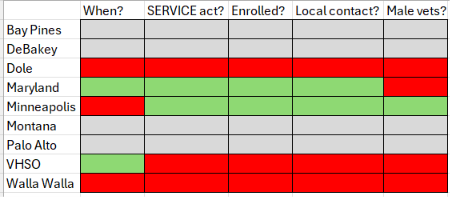
With the above in mind, I compared these posts against five questions from the above. I rated each VAMC based on if I could find the answers on the post, in the infographic, or immediately at the provided link:
When should a female veteran undergo screening for breast cancer?
Was the SERVICE act mentioned?
Do veterans have to be enrolled in VA healthcare to receive a mammogram?
Who can veterans contact locally about mammograms?
Are male veterans at risk of breast cancer?
What the posts say
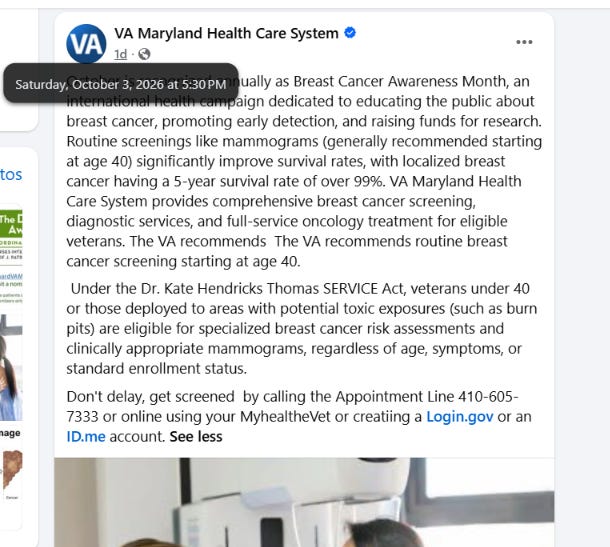
Maryland:
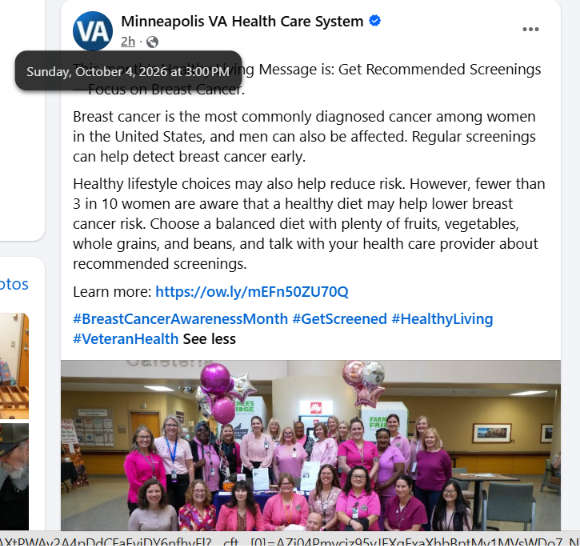
Minneapolis:
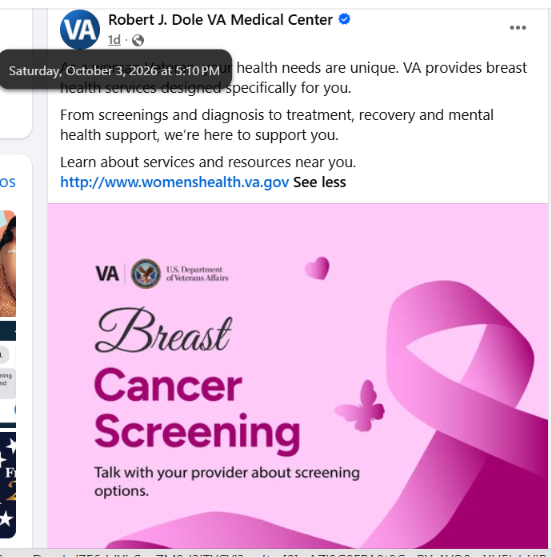
Dole:
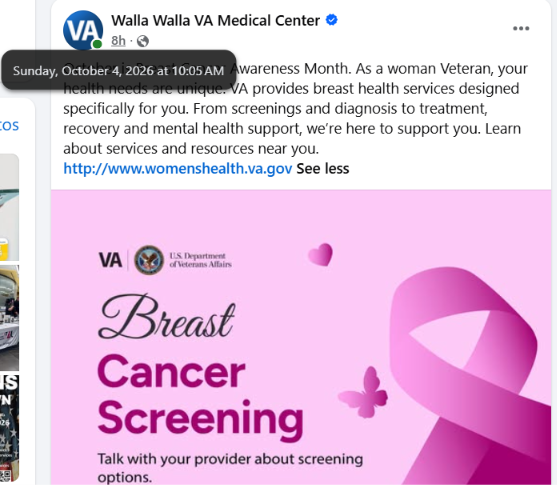
Walla Walla:
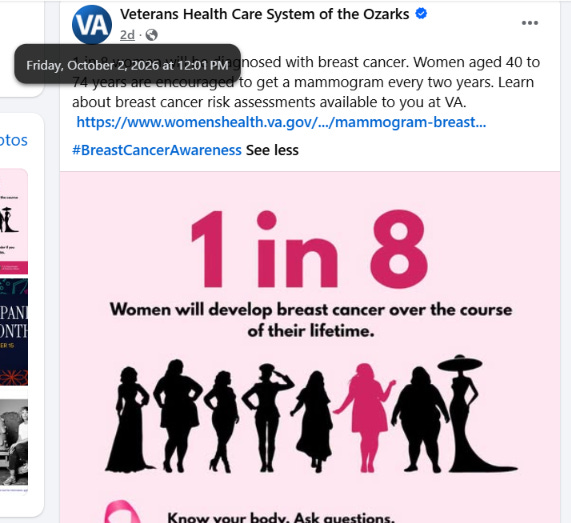
VHSO:
Results
Legend:
Gray: No post4 Green: Go Red: No-go
What I ask VA to do
Put the recommended starting age for mammogram screening in every caption.
Name the SERVICE Act, and
Say plainly whether a veteran needs to be enrolled to receive screening.
Give one local number. The national number is OK, but a local number speeds up the process.
Include a line for men.
Maryland covered most of the above in one caption, so it can be done. Also, please pick one screening guideline. The versions of VA’s mammogram page I found cite the American Cancer Society in one place and the Task Force in another. Veterans deserve one answer.
What I ask the VA to stop doing
Stop ignoring the fact that women are veterans, like VHSO did. There is not a single reference to women veterans in their social media post, and that’s pretty damning. Every other facility found a way to position their posts to women veterans. It’s not difficult.
Stop ignoring that breast cancer, while rare, does affect our fellow veteran brothers. Because male veterans are more likely to die due to breast cancer than female veterans, targeted social media posts directed at male veterans may be worth creating.
What to do now
Ask your VA primary care team for a breast cancer risk assessment, especially if you deployed.
If you’re not enrolled and served in a covered location, call 1-855-VA-WOMEN (1-855-829-6636) and ask about the SERVICE Act.
Found a lump, pain, or discharge? Don’t wait for a screening date.
Tell your provider your family history.
I’ll check these pages again later in October and report what changes.
To date, I have been unable to find anything regarding a VA-wide plan for male veterans who may be at risk of breast cancer due to environmental exposure.
Male Veterans With Breast Cancer Fare Worse Than Females - U.S. Medicine
New VA Rule Blocks Service-Connection Presumption for Male Breast Cancer | VeteranLife
Several VA medical centers had not yet posted about breast cancer as of Oct. 4. That isn't unusual this early in the month.